
Synplified: SynBio put Simply – with Dr. Dhaarsi Jaksch
Author: Noel Gonsalves, Communications Team
Welcome to the second installment in our blog series asking SynBio scientists to explain their research topics using accessible language. As science communicators, it is crucial to describe our work to those without the same experiences as ourselves. Thus, we bring together scientists in varied domains and discuss how they cover scientific concepts with minimal jargon or technical terms, in an effort to improve this skill ourselves.
Key words for this blog post:
Synthetic Biology (SynBio) is an emerging discipline that aims to use non-natural (synthetic) components to recreate existing functions or use existing components—like specific genes—to create new functionalities [1].
Bioengineering is a discipline that applies engineering principles of design and analysis to biological systems and technologies [2].
Dr. Dhaarsi Jaksch is the Chief Scientific Officer of Magmatic Bio, an Austrian startup specializing in bioengineering and metal extraction using ultra-selective metal-binding proteins. Completing her PhD from the University of Vienna, she co-founded Magmatic Bio in 2023 to apply her expertise in protein biochemistry to the problems of metal shortage and destructive metal extraction. We spoke to Dhaarsi about her journey as a scientist-turned-entrepreneur and the intersection of commerce and communication within science. Along the way, we gathered some actionable tips for fellow scientists pursuing entrepreneurship themselves.
“I think the best thing is to just go out and do it. I think scientists in general shy away from big conferences that are not scientific but more like startup events. Just talk to people and pitch them your idea in simple ways. Have a presentation ready. Maybe what you are missing to found a company is a co-founder with a different set of abilities.”
We began by asking Dhaarsi to explain her research at Magmatic Bio as she would to a fellow scientist. “We make ultra-selective metal-binding proteins that can fish out metals—such as rare earth elements, magnesium, and calcium—from complex feed solutions. We turn these proteins into biomaterials, i.e., an immobilized version of the protein… put these biomaterials into columns, and run extraction experiments, [showing] that we can selectively take out the metal we’re interested in.” Speaking about her research team: “[we comprise] computational biologists, who do large database screenings to select candidate proteins… several biochemists, like me, who then perform biochemical screening and small-scale experiments… [and thereafter] a process engineer, who ensures everything works at the industrial scale.” Although, what is the problem they are trying to solve? “We target mining or refining companies who currently have to ship their products to China, for example, to bring their metal to its highest purity.” This process generally employs harsh chemicals dangerous to workers and the environment [3]. Performing such extraction is not feasible in Europe, and to thus reduce the monetary and environmental costs of shipping and extraction, Magmatic Bio uses SynBio to create new metal-refining technologies. It was clear that Dhaarsi had ample experience laying out her company’s strategy beat-by-beat.
“Now how would you explain this in an approachable manner for general audiences?”
Dhaarsi confessed this was the part that she, like many academics, found more challenging. “Communicating to people who are not scientists… I struggle with simplifying what we do, but what I usually say is that we develop proteins. We know that everybody has proteins—like insulin that can reduce your blood sugar or antibodies that can target COVID—but we [at Magmatic Bio] develop different proteins that do one very specific task.” Dhaarsi proceeded to illustrate the research problem using everyday objects and scenarios: “Let’s say you have 99 blue balls and one red ball, and you want to fish out the red ball. This is what our protein can do, and we make it such that it only does this one task.” Escalating to the industrial scale, she continued “We then develop a process so that a mining company can use this protein, run their solutions over it, and fish out the red ball.” She reiterated the need to demystify the process and minimize jargon using terms that are likely more understandable to general audiences (e.g., “reactor” instead of “column”). Although, one must remain prepared for follow-up questions since you cannot always know your audience’s experience. In general, this can be a fun exercise for a science communicator.
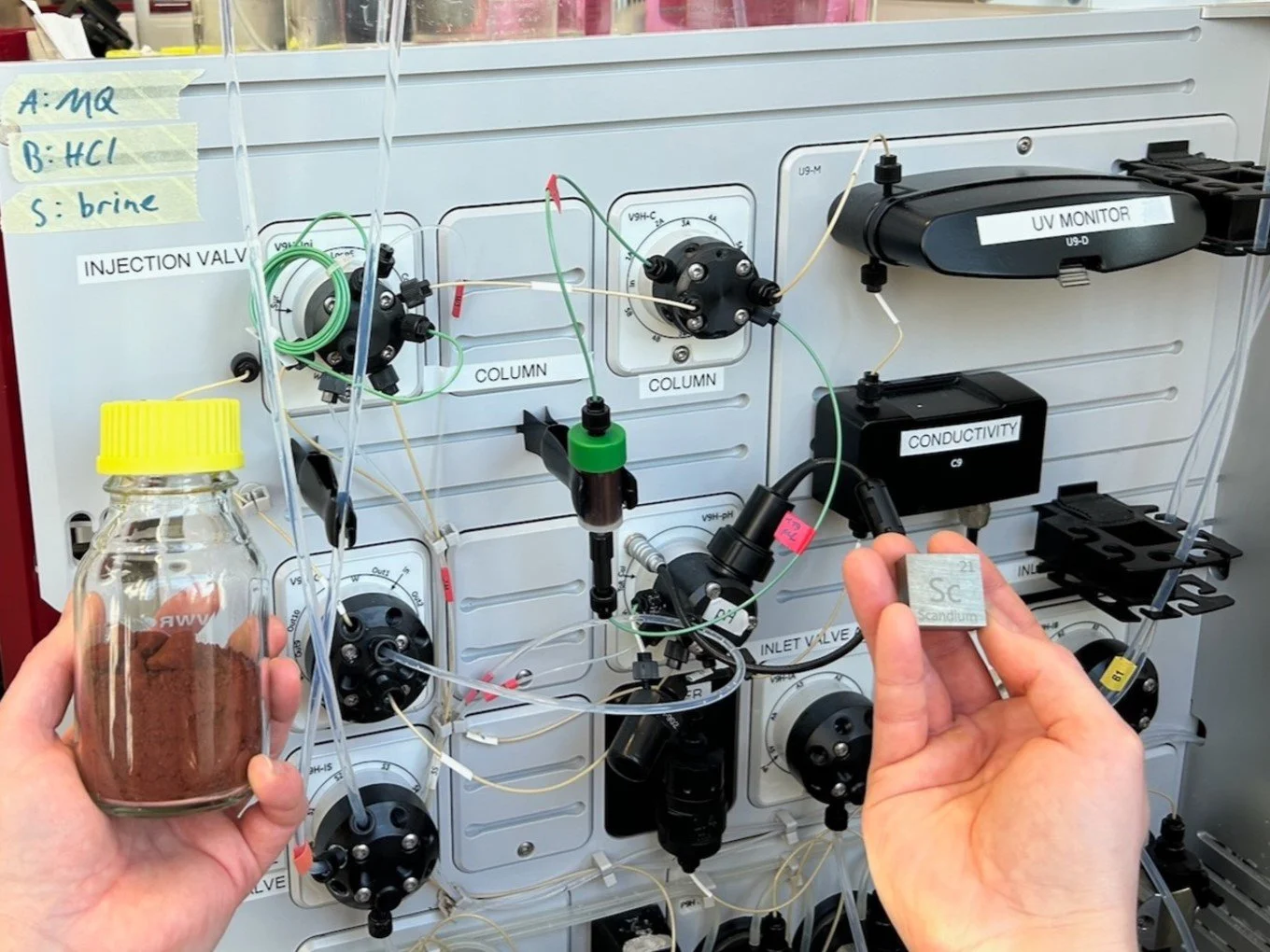
Metal-extraction apparatus, wherein a metal-containing powder is dissolved in solution and run through an extraction column to procure valuable metals (in this case, scandium).
Picture credits: Magmatic Bio.
“At some point, I didn’t really know why anybody would care for my research, which I think happens to everybody at some point… I couldn’t see myself in academic research anymore.”
Since the path from academia to entrepreneurship is not the most conventional, we asked Dhaarsi what motivated her to co-found a startup after being a researcher for over 8 years. “What I liked about co-founding this company was the topic that we addressed. [Fundamental research in] protein and RNA biochemistry in my PhD was awesome in the beginning. I liked my project but at some point, I didn’t really know why anybody would care for my research, which I think happens to everybody at some point during a PhD or Master’s. I couldn’t see myself in academic research anymore because I knew how long it takes until something bears fruit.” After completing her PhD, Dhaarsi recounted how she met her future co-founder Oliver Siegel and learned that his budding biotech company was seeking a biochemist to purify and engineer metal-binding proteins to “develop new technologies that are more environmentally friendly and really bring to life the climate goals Europe has.” She offered the example of electric cars, whose batteries need refined metals that—unbeknownst to most—have to be sourced from other continents. “This project was something that could affect our daily life and bring about a very disruptive technology, and I thought ‘I can do this protein biochemistry?’ I would have never thought so.” This was the spark that led to her joining Magmatic Bio as a protein biochemist.
There was a personal angle to this as well. “At some point, Oliver asked me to be co-founder and at first, I said no. I was just married, wanted to have a kid, and believed that it’s impossible to be a mother and a co-founder.” However, upon gathering perspectives from several peers, Dhaarsi agreed to be a co-founder because “you can build a company, shape your team, and shape your research in a way that you could not anywhere else.” Speaking to other mothers and co-founders in her network from several countries, Dhaarsi figured out a system through which she can accomplish both roles. “I think especially as a woman in this field, it’s very important for me to mention that I am a co-founder and a mother.”
Communicating one’s research to non-scientific audiences is also necessary when interfacing with the corporate sphere, investors, and policymakers—in a manner quite different from general public discourse. As Chief Scientific Officer representing her company at trade fairs or conferences, we asked Dhaarsi if the economic incentives behind managing a business affect how she communicates about her research itself. She explained: “If I talk to an investor, I talk much more about the problem and its solution instead of explaining in detail our process of engineering the proteins, for example. I just say that we develop a bio-based solution that can change how metals are refined. When people are then interested in the actual science, I wait for follow-up questions and reply to them thereafter.” Dhaarsi emphasized that one should “really focus on the problem and the economic value. This could mean you have reduced process costs and chemical consumption, you can build it in Europe, and [thus] make money here.” An important takeaway is thus to focus on the end rather than the means, i.e., the product you are offering rather than the details about your process. This “sales mindset” is different from how academics traditionally communicate their research, although there has been a growing trend in instructing academics—even graduate students—to present their work as a problem-and-solution narrative rather than a list of methods and results.
Besides communicating scientific research, another challenge Dhaarsi raised was making it clear to audiences that great results in the lab do not perfectly translate to a large industrial process. “We need time to understand our protein and the different processes. Something I notice is that investors and [many] people don’t understand why we still need two years until we can enter the market. I think the main reason is that everybody thinks about software when they look into startups, and software businesses are just very fast compared to what we do.”
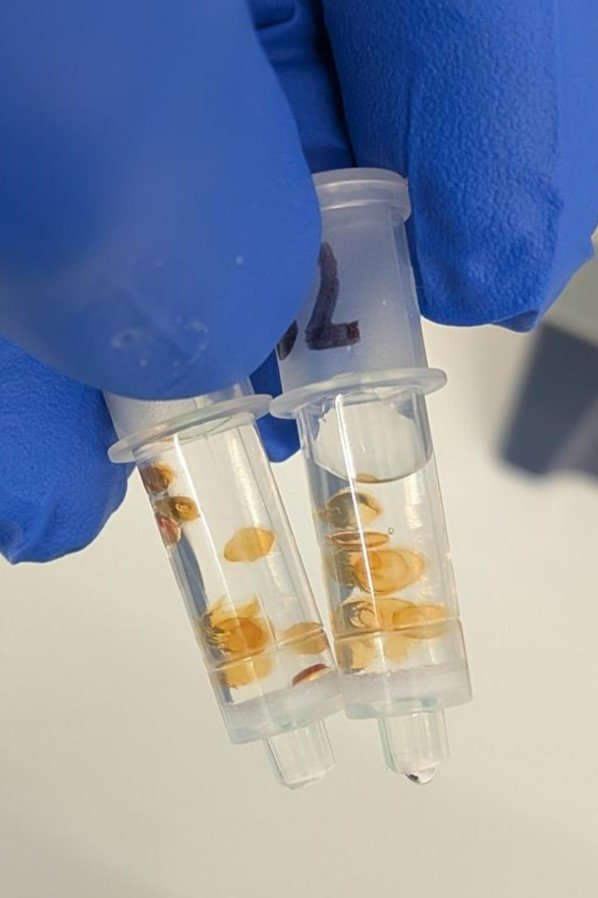
The biomaterial (immobilized protein) used by Magmatic Bio to extract valuable metals out of feed solutions.
Picture credits: Magmatic Bio.
Another aspect of communicating one’s research is public perception, particularly when using SynBio to tackle a commercial problem. We asked Dhaarsi if she feels that the general public is aware of SynBio approaches to industrial problems, or if she thinks conventional chemical methods are still pervasive in the public consciousness. “I think it’s the second case, and we have to still explain what synthetic biology is. People are likely to first think about microorganisms... They may then ask: is it dangerous to the environment, or what if it leaks?” She suggested that the public may conflate SynBio with genetically modified organisms (GMOs) as well, and that controversial association may stoke concern. Recently, the UK government adopted the term “engineering biology” as a modern extension of SynBio to focus on its commercial applications and revitalize its public image [4,5]. Dhaarsi confessed that she rarely uses the term “synthetic biology” during her communications and was uncertain if such rebranding efforts would change the perception of this rapidly evolving field.
Lastly, we asked Dhaarsi if she had any advice for scientists who are considering entrepreneurship. “I think the best thing is to just go out and do it. I think scientists in general shy away from big conferences that are not scientific but more like startup events; but just go try it out and you will get better with time.” Since this advice was geared towards those who already have an idea for a company fleshed out, we asked Dhaarsi what a scientist at an earlier stage in their entrepreneurial journey could do. “You can still go to startup events even if you don’t have a company yet. Just talk to people and pitch them your idea in three or maximum four minutes in simple ways. Have a presentation ready, because often [your audiences] want to see a presentation. Then, you also notice where you have to refine your startup idea or how you present it.” Another crucial benefit to attending such events: “Maybe what you are missing to found a company is a co-founder with a different set of abilities.” On a practical note, Dhaarsi commented “Obviously, these events cost money. Before you have founded a company, you either have to pay for yourself or if you are in a university that has a startup program, you can avail of that.”
There may be several scientists who dream about starting their own company but do not move past that. Alongside her practical tips, we asked Dhaarsi if there is a mindset shift involved when transitioning from research to entrepreneurship. “I think having a romantic ideal is part of it, but you always have to think about the economics. Can you make money? Because this is the first question that an investor, for example, will ask you. For scientists this is often not the most important, because they want to build something.” She harkened back to her motivation for using protein engineering to solve a massive global issue: “I want to build something that changes [something] in a big, big, big way; but in the end, it still matters if money is made. You have to think about it and have it in your presentation as well.”
This contrast between academics and entrepreneurs seems quite stark at first, but Dhaarsi made us realize that not only does this transition happen often, but it can be a very fulfilling journey for scientists seeking more autonomy and more targeted impacts of their work. Crucially, learning to communicate one’s work to non-specialist audiences is a skill that serves one well in both domains. Dhaarsi’s experiences outline that regardless of your goals, communication truly underlines your success as a scientist. We are most invested in getting this message out to our fellow SynBiologists, and we hope this motivates you to talk about your research well, to whomever you feel should listen!
We thank Dr. Dhaarsi Jaksch for being a part of our blog series. You can find her company Magmatic Bio here. You can find the previous entry in our blog series here and get in touch with us here, if you are also interested in sharing your research topic in plain language!
Sources:
Benner, S. A., & Sismour, A. M. (2005). Synthetic biology. Nature reviews genetics, 6(7), 533-543. https://doi.org/10.1038/nrg1637.
Han, Y. H., Cui, X. W., Zhang, Y., Zhang, H., & Chen, Z. (2025). Environmental impacts of rare earth elements mining and strategies for sustainable management: A comprehensive review. Journal of Hazardous Materials, 140400. https://doi.org/10.1016/j.jhazmat.2025.140400.
https://www.ukri.org/what-we-do/browse-our-areas-of-investment-and-support/synthetic-biology/
Images provided by Dr. Dhaarsi Jaksch on behalf of Magmatic Bio.