
The iGEM Registry: building the next generation of synthetic biology infrastructure
iGEM is a global synthetic biology organization dedicated to education, competition, innovation, and community-building. One of its major activities, the iGEM Competition, grew out of an Independent Activities Period course at MIT that began with just five participating teams. Over the past 23 years, the competition has expanded to bring synthetic biology to the global stage, hosting more than 5,500 teams from 69 countries. In the 2025 competition, 74 teams from institutes across Europe participated. For the 2026 Competition alone, around 430 teams from around the world are now registered.
Alongside the growth of the iGEM Competition, the iGEM Registry of Standard Biological Parts has become a central resource for the synthetic biology community. What began in 2003 as a shared excel spreadsheet has grown into a global repository containing over 84,000 DNA parts, experimental records, and community contributions generated primarily through the iGEM projects.
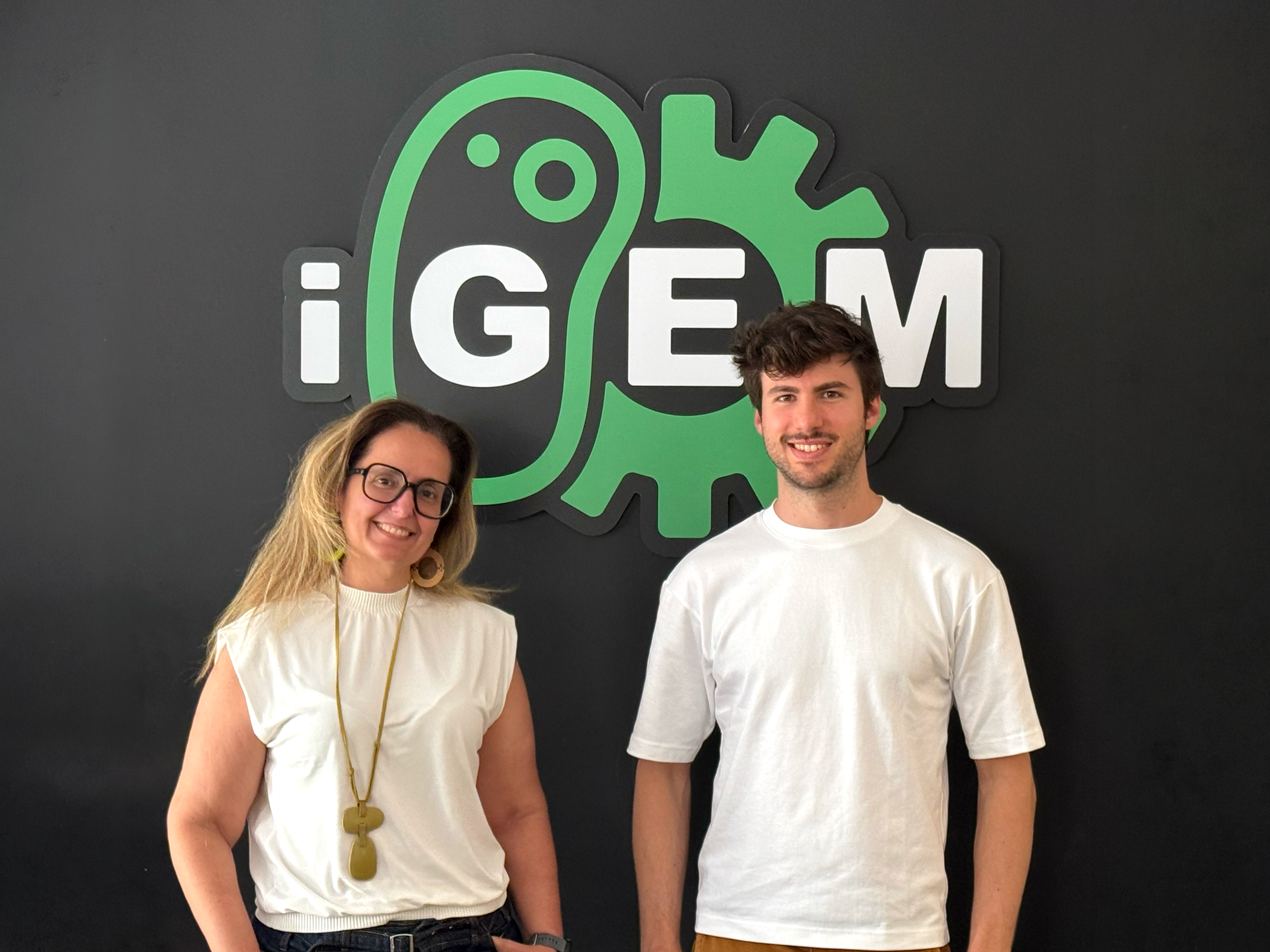
Mary Pavan (left) and Fabio Maschi (right) at iGEM headquarters. Image credits: iGEM.
We spoke with Fabio Maschi and Marilene (Mary) Pavan, who are leading the Registry’s redevelopment. During our conversation, they described how the project is far more than a technical upgrade. For the newly formed Registry Steering Committee, it is an opportunity to rethink how synthetic biology data are documented, shared, and accessed by a global community.
“The registry has been around for more than 20 years,” Fabio explained. “In the beginning, they were in a way building the field. Many things were unknown. They had to discover and learn as they were developing things.”
The original Registry provided a centralized, open platform where iGEM teams could share standardized biological parts and collaborate across institutions and countries. But in the age of AI, the tools, standards, and expectations of synthetic biology have rapidly evolved. The Registry team now sees a need to modernise the platform to support cutting-edge workflows.
A registry for the next generation
“We always knew that this was something we needed to do,” Fabio said. “Now we have a clear plan, and the team, to rebuild the Registry on modern foundations.”
The revamping project is being guided by an international steering committee of around twenty synthetic biology experts, alongside a development team of five engineers. Mary, the Director of Technology at iGEM, described how the Registry redevelopment is closely tied to a broader restructuring of iGEM’s technology efforts. What was previously known as the iGEM Engineering Committee has expanded into a much larger Technology Committee, bringing together 38 contributors across working groups focused on chassis engineering, standards, software, AI, and education.
Their shared goal is to make the Registry more usable, accessible, and consistent for the wider synthetic biology community, while updating the platform to better support emerging computational tools.
Fabio described the roadmap in two broad stages. The first is focused on updating the platform itself by rebuilding the infrastructure, improving security, and redesigning the underlying data model to bring the platform in line with where synthetic biology has already moved. The second stage is more ambitious. Rather than simply keeping pace, the Registry aims to lead; turning two decades of experimental records into high-quality, structured data that researchers can actually build on, and making it accessible through AI. Fabio explained the focus is not only on “the part itself”, but also “the context of these parts and the experiments and the data”. Together, these changes aim to make the Registry easier for researchers to navigate and identify parts of interest, while also making the data more useful for future computational analysis.
Fabio gave the example of chassis data: historically, it could be difficult to identify whether a part had been designed for E. coli, mammalian cells, or another organism entirely. The new system aims to integrate this kind of contextual information more directly into the Registry structure, making it easier for researchers to identify relevant parts while also improving the usefulness of the data for future computational analysis.
Tackling standard adoption across a global community
At the core of the redevelopment lies a deceptively difficult challenge: data standardization.
During the past 23 years, the Registry has accumulated roughly 90,000 genetic parts, with over 84,000 associated documentation records containing experimental notes, annotations, and characterization data. This information is invaluable but was contributed by thousands of teams using vastly different methodologies, equipment, and reporting styles.
“It’s intrinsic to our field to have different ways to generate, interpret, and share data,” Mary noted. This challenge is familiar in the European synthetic biology landscape, where research is often spread across large international collaborations and shared research infrastructures.
Modern AI can read this kind of free-text record without much trouble. The harder problem is comparability and trust: when thousands of teams describe their work in different ways, it becomes difficult to compare results across parts, connect records to the wider body of biological knowledge, and be confident that an answer drawn from the data is grounded in real evidence rather than a plausible guess. This is where standards do their work: they make the data comparable across contributors, connect it to the wider ecosystem through shared identifiers and vocabularies, and make machine-generated answers trustworthy enough to build on.
Mary explained that one of the major priorities for the coming year is closer collaboration between the Registry and iGEM’s broader Technology Committee to develop clearer standards for how teams submit documentation, protocols, and experimental results.
“What we are doing now is really preparing the foundations,” Fabio said, “so the analysis we run later can draw on data that's far higher in quality, and far better structured”.
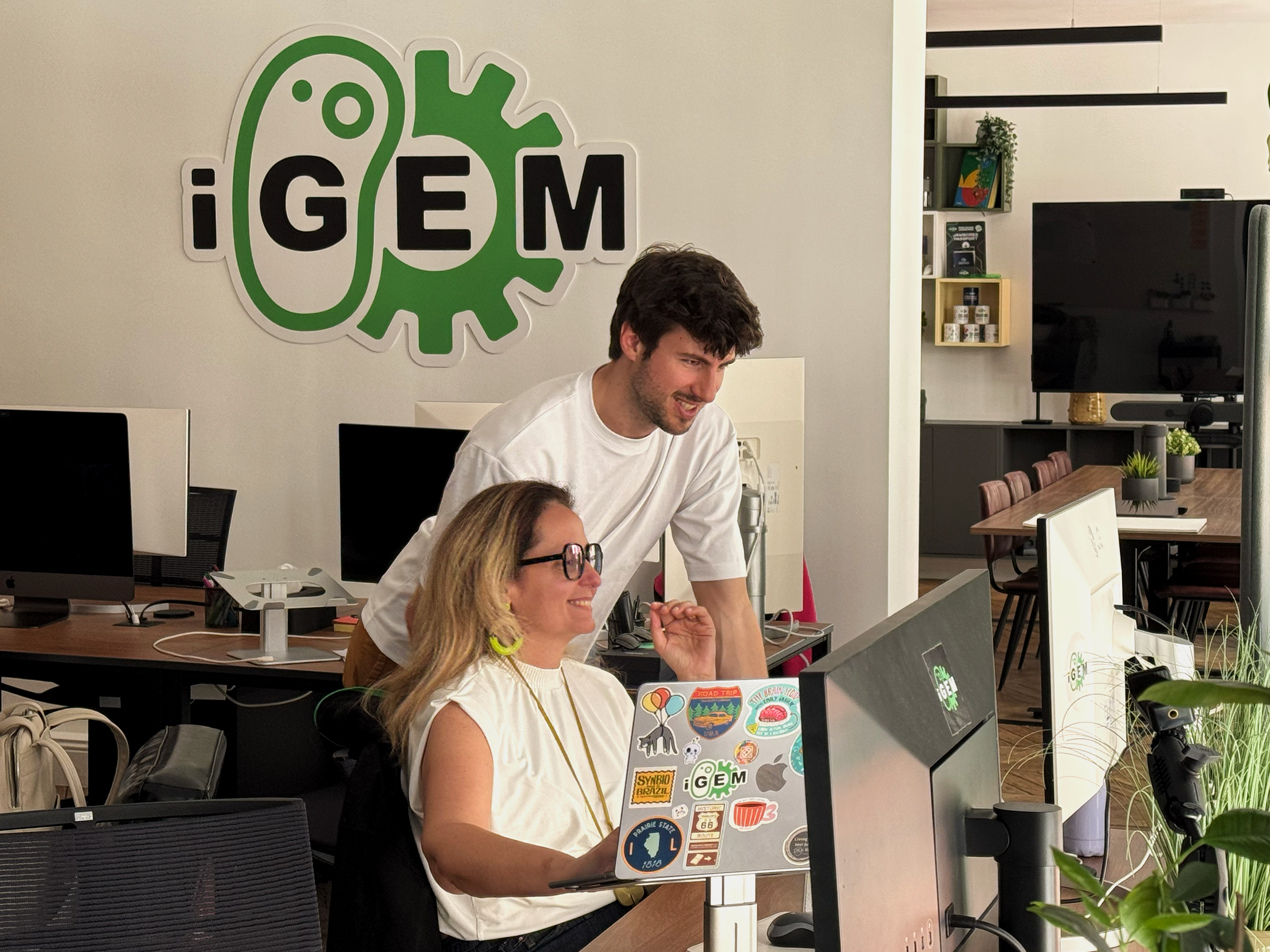
Fabio and Mary working on prototyping the new iGEM Registry. Image credits: iGEM.
AI, accessibility, and new ways to approach biology
Fabio’s background in computer science and electrical engineering strongly shapes his perspective on the field. He pointed to the historical inspiration synthetic biology drew from electronics, where standardized components and datasheets allowed engineers to build increasingly complex systems. Notably, two of iGEM’s founders, Tom Knight and Randy Rettberg, are electrical engineers by training and played early roles in developing technologies that laid the foundations for the internet.
“The Registry and the BioBricks concept started from this huge inspiration from electronics,” Fabio highlighted. “Trying to standardize components and understand how they interact.”
Now, he believes AI could fundamentally change how people interact with biological information altogether. “With AI, we can really raise the level of interaction that the user is having with the data. They don’t need to fully understand the low details of these parts…but they can talk to AI to understand.”
Fabio pointed to how team members from mathematics and computer science backgrounds may approach the Registry differently, focusing less on the true biological meaning of individual parts and more on how different components relate and interact with one another. He described this as thinking about the Registry as a “knowledge graph” of biological relationships and how this can open up new ways for people from different disciplines to contribute to the field.
For Mary, a metabolic engineer by training, accessibility also means improving educational infrastructure. One major priority for the coming year is expanding educational content and ensuring the Registry becomes understandable not only to iGEM participants, but to a much broader scientific audience. “We are working with committee members to be sure that the language goes beyond the iGEM Competition,” she said.
Open science at the core
Throughout our conversation, both Fabio and Mary repeatedly returned to the idea that iGEM’s role in the synthetic biology ecosystem is fundamentally community-oriented.
“Our interest is really to democratize access to this knowledge and to this field,” Fabio said. “We’re really fostering openness because we believe that more people accessing this field can develop it even more.”
Their philosophy aligns closely with the FAIR data principles (making scientific data Findable, Accessible, Interoperable, and Reusable), which the team referenced as a guiding framework for the new Registry.
Importantly, openness is being balanced with increasing attention to biosecurity. Historically, screening Registry submissions for hazardous sequences was largely a manual process. The new system introduces automated DNA screening pipelines, enabled by collaboration with organisations such as SecureDNA and IBBIS.
"Every part is screened against known hazards before publication, using specialised third-party tools built specifically for that work," Fabio explained." And we stay in close contact with the providers behind them, not just running the screening, but helping to inform how this kind of hazard screening develops as a field."
The automation of these safeguards reflects the team’s broader effort to institutionalise responsible practices directly into the Registry’s infrastructure.
Beyond iGEM: building a global infrastructure for synthetic biology
Perhaps the most striking aspect of our conversation was the scale of iGEM’s potential data ecosystem. Each year, hundreds of teams generate experimental results, protocols, and characterization data through their projects. The most recent annual competitions have involved more than 400 teams worldwide.
“Think about the amount of scientific data that is being generated by these teams”, Mary remarked, “If we can properly capture this data in the Registry, this is super powerful for the community.”
The long-term vision extends further still. Both Mary and Fabio see a future where the Registry opens fully to the wider synthetic biology community, so that researchers beyond iGEM can contribute parts and experimental data directly.
The ambition is clear: a Registry that becomes one of synthetic biology's central public infrastructures (open, interoperable, and AI-ready) serving everyone working in biological engineering.
For now, the focus is on the foundations that make that possible. "We're doing our homework," Fabio concluded, "so this platform is genuinely ready to be one of the foundational resources the field can build on."